
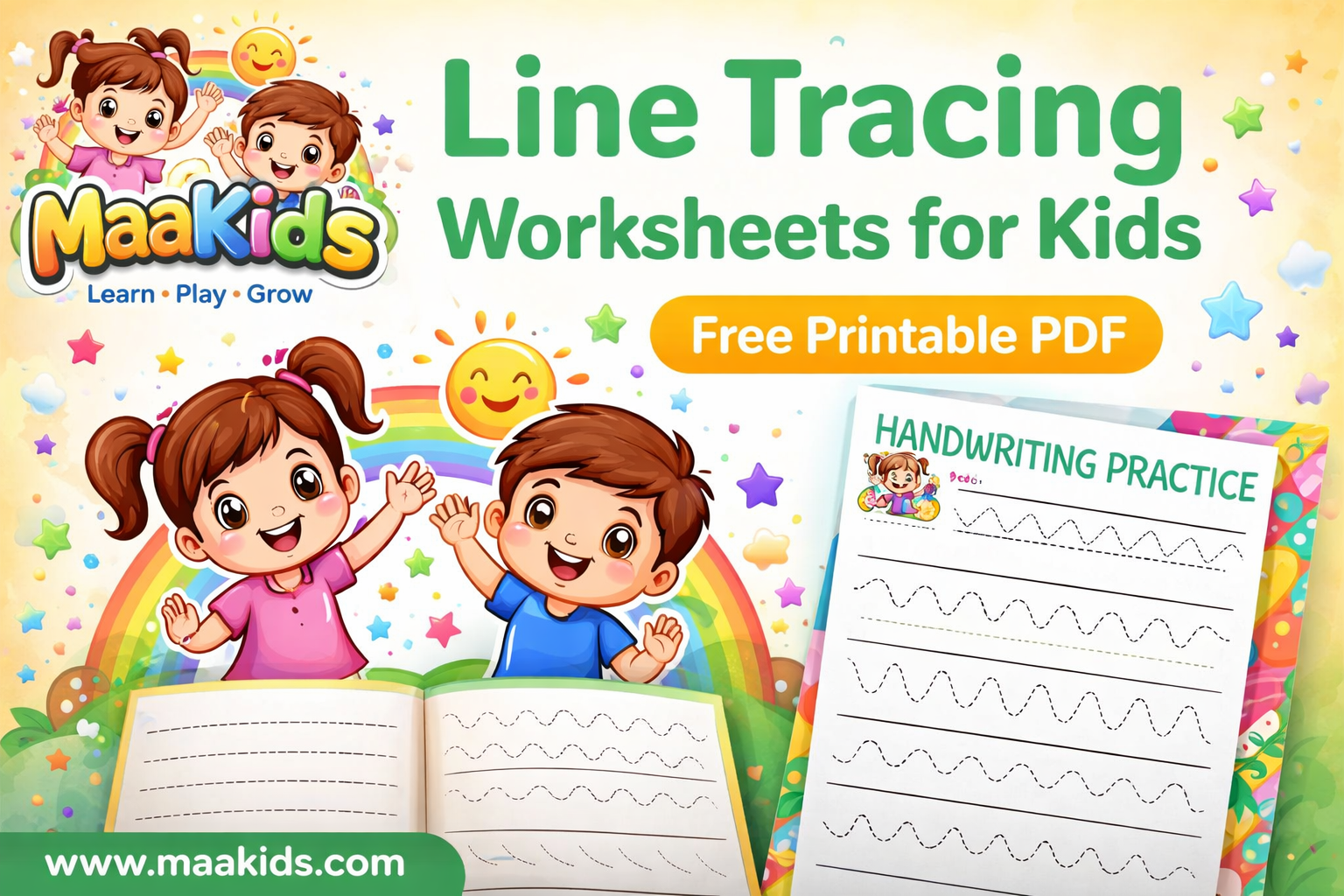
Help Your Little One Build Writing Confidence One Line at a Time
Before a child can write their name, draw a shape, or sketch their first picture, they need to master something surprisingly simple — the line. Line tracing is the very first step in every child’s handwriting journey, and it’s one of the most powerful pre-writing exercises you can give your toddler or preschooler.
At Maakids, we’ve created a collection of free printable line tracing worksheets designed to make this foundational skill fun, engaging, and screen-free.
What Are Line Tracing Worksheets?
Line tracing worksheets are simple activity sheets where children follow dotted or dashed lines using a pencil, crayon, or marker. The lines may be:
- Straight lines (horizontal, vertical, and diagonal)
- Curved lines and wavy patterns
- Zigzag lines
- Spiral lines
- Pre-writing pattern lines that prepare kids for letter formation
These sheets are typically used with children aged 2 to 5 years, though they can be helpful for kindergarteners who need extra fine motor practice.
Why Are Line Tracing Worksheets Important?
You might wonder — isn’t tracing just busywork? Not at all! Here’s what happens in your child’s brain and hands while they trace:
✏️ 1. Fine Motor Skill Development
Tracing requires children to control small muscles in their fingers, hands, and wrists. This muscle control is the same they’ll use for writing letters and numbers later.
🧠 2. Hand-Eye Coordination
Following a line on paper teaches the brain and hand to work together — a skill essential for reading, writing, and even everyday tasks like buttoning a shirt.
✋ 3. Pencil Grip Practice
Worksheets encourage proper pencil grip early, helping children avoid developing bad habits that are hard to break later.
🎯 4. Focus and Concentration
Staying on a line requires attention and patience. Regular practice builds a child’s ability to sit still and focus — important for school readiness.
📝 5. Pre-Writing Foundation
Every letter of the alphabet is made up of lines and curves. Mastering line tracing means your child is already halfway to writing!
What’s Included in Our Free Printable PDF?
Our Maakids Line Tracing Worksheet PDF includes a variety of exercises to keep kids engaged and challenged as they progress:
| Worksheet Type | Best For |
|---|---|
| Horizontal straight lines | Beginners (ages 2–3) |
| Vertical straight lines | Beginners (ages 2–3) |
| Diagonal lines | Intermediate (ages 3–4) |
| Wavy & curved lines | Intermediate (ages 3–4) |
| Zigzag lines | Intermediate (ages 3–4) |
| Mixed pattern lines | Advanced preschoolers (ages 4–5) |
| Spiral tracing | Advanced preschoolers (ages 4–5) |
All worksheets feature:
🆓 Completely free — no sign-up required
🎨 Bright, cheerful designs kids actually want to use
📏 Thick, clear dotted lines that are easy to follow
🖨️ Print-ready PDF format — just download and print
How to Use These Worksheets
Getting the most out of line tracing is simple. Here are a few tips:
1. Set up a comfortable writing space. Make sure your child is seated at a table with their feet flat on the floor and the paper at a slight angle.
2. Demonstrate first. Show your child how to trace the line before handing them the pencil. Say it out loud: “We start here and go this way.”
3. Let them use their favourite tool. Crayons, coloured pencils, washable markers, or a regular pencil all work. Mix it up to keep it exciting!
4. Celebrate effort, not perfection. A wobbly line is still a great line! Praise your child’s attempt and focus on the process, not the outcome.
5. Laminate and reuse. Print once, laminate the sheet, and let your child use a dry-erase marker. This is a great way to practice repeatedly without wasting paper.
Tips for Parents and Educators
- Start slow. If your child is very young (2–3), begin with just one or two lines per session. Short, positive practice is better than long, frustrating sessions.
- Make it a routine. 5–10 minutes of tracing a day can lead to visible improvement within weeks.
- Pair with play. Encourage your child to trace roads for toy cars, paths for animals, or trails for their favourite characters to make it imaginative.
- Track progress. Save completed worksheets in a folder. Looking back at their improvement is a huge confidence boost for little learners.
Who Can Benefit From Line Tracing Practice?
Line tracing worksheets aren’t just for neurotypical children. They can be especially helpful for:
- Children with developmental delays who need extra motor skill practice
- Kids with dysgraphia or difficulty with handwriting
- Children with autism who benefit from structured, repetitive activities
- ESL learners who are just beginning to write in a new language
- Homeschooling families looking for structured, affordable printables
Always consult with your child’s teacher or therapist if you’re using worksheets as part of a therapeutic or educational plan.
Frequently Asked Questions (FAQ)
❓ At what age should kids start line tracing?
Most children can begin simple line tracing as early as 2 to 2.5 years old, starting with thick horizontal and vertical lines. By age 3–4, they’re typically ready for curves, diagonals, and zigzags. Every child develops at their own pace, so follow your child’s interest and readiness rather than strictly following age guidelines.
❓ How long should a line tracing session be?
For toddlers (ages 2–3), keep sessions to 5 minutes or less to match their attention span. For preschoolers (ages 3–5), 10–15 minutes per session is ideal. Always stop before the child gets frustrated — short, positive sessions are far more effective than long, forced ones.
❓ What tools should my child use for tracing?
Any of the following works great:
- Thick crayons — easiest grip for toddlers
- Washable markers — satisfying and smooth for young hands
- Coloured pencils — good for building pencil pressure control
- Regular HB pencil — best for older preschoolers preparing for school writing
Avoid very thin pens or fine-tip markers for children under 4, as they require more control than small hands typically have.
❓ Are these worksheets suitable for left-handed children?
Absolutely! Line tracing worksheets work just as well for left-handed children. The only adjustment needed is to ensure your child starts tracing from left to right (for horizontal lines) and that their paper is angled slightly to the right for comfort. Left-handedness is completely normal, and these sheets support all learners equally.
❓ My child keeps going off the lines. Should I be worried?
Not at all — this is completely normal, especially for beginners! Going off the line simply means the fine motor muscles are still developing. With regular, relaxed practice, most children show noticeable improvement within 2 to 4 weeks. Focus on encouragement rather than correction. If you notice significant difficulties persisting beyond age 5, consider speaking with a paediatric occupational therapist.
❓ Can these worksheets be used in a classroom or daycare setting?
Yes! Our free printable PDF is perfect for classroom use. Teachers and educators are welcome to print as many copies as needed for their students at no cost. The worksheets are designed with classroom use in mind — clear visuals, appropriate sizing, and a range of difficulty levels to suit mixed-ability groups.
❓ Do I need to create an account to download the worksheets?
No account, no email, no sign-up needed. Just click the download button and your free PDF is ready to print instantly. Maakids believes every child deserves access to quality learning materials — completely free.
❓ How are line tracing worksheets different from letter tracing worksheets?
Line tracing worksheets focus purely on basic strokes — straight, curved, diagonal, and wavy lines — without any letters or numbers. They are the step before letter tracing. Once a child can confidently control a pencil along varied line types, they are much better prepared to trace and eventually form letters independently. Think of line tracing as the building block that makes letter tracing easier and more successful.
❓ What comes after line tracing?
Once your child is comfortable with line tracing, the natural next steps are:
- Shape tracing (circles, squares, triangles)
- Pre-writing pattern worksheets
- Letter tracing (A–Z)
- Number tracing (1–20)
- Name writing practice
Maakids has free printables for every stage — explore our full library below!
Download Your Free Line Tracing Worksheets PDF
Ready to get started? Our free printable PDF is available for instant download right here on Maakids. No email required, no hidden fees — just a beautifully designed worksheet pack to support your child’s learning journey.
👉 [Download Free Line Tracing Worksheets PDF]
Print, grab a crayon, and watch your little one grow — one line at a time. 🖍️
More Free Printables You’ll Love on Maakids
Looking for more activities? Explore our growing library of free educational printables for kids:
- ✏️ Letter Tracing Worksheets A–Z
- 🔢 Number Tracing Worksheets 1–20
- 🔷 Shape Tracing Worksheets
- 🎨 Colouring Pages for Toddlers
- 📚 Pre-Writing Pattern Worksheets
Published by Maakids | Free Printables for Early Learners Tags: line tracing worksheets, free printable PDF, preschool worksheets, fine motor skills, pre-writing practice, toddler activities, kindergarten printables, Maakids