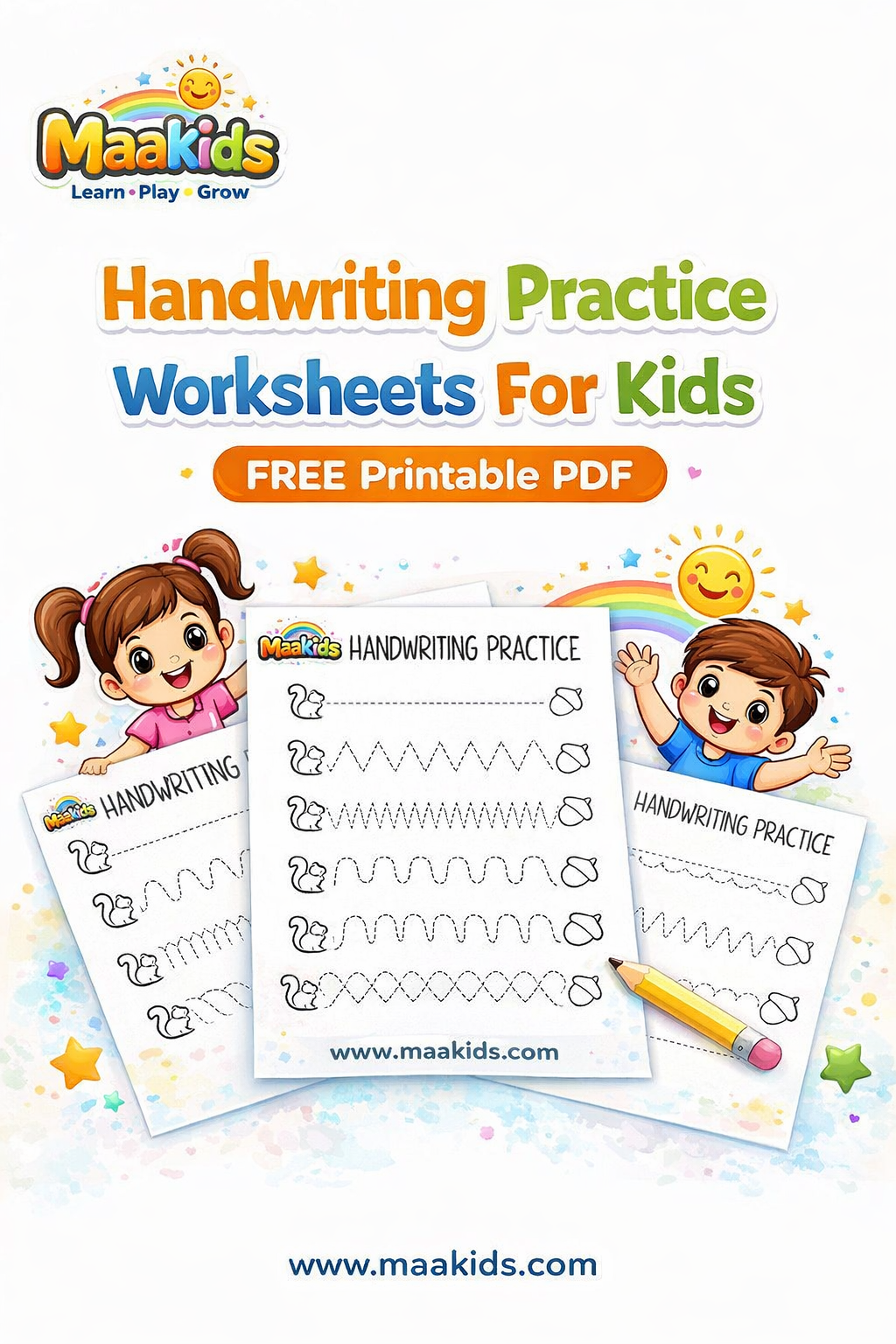
Good handwriting is one of the most foundational skills a child can develop. Before your little one can write a story, take a test, or even sign their name, they need the confidence that only comes from regular, guided practice. That’s why we’ve put together a free collection of printable handwriting practice worksheets for kids — designed to make learning fun, structured, and screen-free.
Whether your child is just starting to grip a pencil or already writing words but needs to tighten up their letter formation, you’ll find the right worksheet right here. All PDFs are free to download and print at home.
📋 In This Post You’ll Find:
- Why Handwriting Practice Still Matters
- When Should Kids Start Practising Handwriting?
- Types of Handwriting Worksheets We Offer
- Free Printable Handwriting Worksheets (PDF Download)
- Tips for Parents & Teachers
- Frequently Asked Questions
✏️ Why Handwriting Practice Still Matters
In a world full of tablets and keyboards, you might wonder — does handwriting even matter anymore? The answer is a resounding yes. Here’s why:
- Brain development: Studies show that writing by hand activates more areas of the brain than typing, boosting memory and comprehension.
- Academic performance: Children who write neatly tend to express more ideas in essays and score better on written exams.
- Fine motor skills: Holding and controlling a pencil strengthens the small muscles in the hand and fingers — skills that transfer to many other activities.
- Focus & patience: Handwriting requires slowing down and paying attention — two habits that benefit kids in every area of school life.
- Self-expression: A child’s handwriting becomes uniquely their own. It’s a form of identity and pride.
At Maakids, we believe every child deserves a strong start. That’s why our worksheets are crafted with care — balancing structure with fun so kids actually want to pick up that pencil.
🗓️ When Should Kids Start Practising Handwriting?
There’s no one-size-fits-all answer, but here’s a general age-by-age guide:
| Age / Stage | What to Focus On | Recommended Worksheets |
|---|---|---|
| 3–4 years | Pencil grip, pre-writing strokes, basic lines & curves | Pre-writing patterns, shape tracing |
| 4–5 years (Pre-K) | Uppercase letter tracing, name writing | Uppercase alphabet tracing sheets |
| 5–6 years (Kindergarten) | Uppercase & lowercase letters, simple CVC words | Alphabet A–Z tracing, word tracing |
| 6–7 years (Grade 1) | Words, short sentences, spacing between words | Sentence handwriting, sight words |
| 7–9 years (Grade 2–3) | Paragraphs, cursive introduction, speed & fluency | Paragraph practice, cursive tracing |
💡 Pro tip: Keep practice sessions short — 10 to 15 minutes daily is far more effective than one long weekly session.
📄 Types of Handwriting Worksheets We Offer
Our free printable worksheets are organised by skill level and writing style. Here’s a breakdown of what you’ll find:
1. Pre-Writing Pattern Worksheets
Before letters come lines and curves. These worksheets help toddlers and preschoolers build the muscle control and coordination needed for letter formation. Activities include tracing zigzags, loops, wavy lines, and diagonal strokes.
2. Uppercase Alphabet Tracing Worksheets (A–Z)
Each sheet focuses on a single uppercase letter with large, guided tracing paths and arrows showing stroke direction. Includes picture cues to help kids associate letters with words (e.g., A for Apple).
3. Lowercase Alphabet Tracing Worksheets (a–z)
Often trickier than capitals, lowercase letters have more variation. Our worksheets use dotted guidelines and step-by-step stroke guides to help kids master every letter from A to Z.
4. Full Alphabet A–Z Practice Sheets
Complete alphabet sheets showing both uppercase and lowercase letters together. Great for daily review and building consistency across all 26 letters.
5. Number Writing Worksheets (0–20)
Handwriting isn’t just for letters! These sheets help children trace and independently write numbers with correct stroke formation — an essential early math skill.
6. Sight Words Handwriting Worksheets
Practice the most common Dolch and Fry sight words through tracing and independent writing. Builds both handwriting fluency and reading vocabulary at the same time.
7. Sentence Handwriting Worksheets
Short, age-appropriate sentences printed in dotted/traced format. Focuses on word spacing, punctuation placement, and writing on a baseline — perfect for Grade 1 and up.
8. Cursive Handwriting Worksheets
For children ready to connect their letters, our cursive sheets introduce each letter with clear joining guides. Cursive improves writing speed and is still required in many school curricula.
9. Name Writing Practice
Customisable sheets where kids can trace and then independently write their own name — a hugely motivating milestone for early learners.
📥 Free Printable Handwriting Worksheets – PDF Download
All worksheets below are 100% free, printer-friendly PDFs. Simply click the download button next to the set you need, print at home or at school, and you’re ready to go!
🖨️ Printing tip: Print on standard A4 or Letter-size paper. For younger children (3–5), consider printing at 120% scale for larger writing space. Use cardstock if you want to laminate sheets for reuse with dry-erase markers.
🧑🏫 Tips for Parents & Teachers: Getting the Most From These Worksheets
Worksheets are tools — how you use them matters just as much as the sheets themselves. Here are our top tips:
✅ Create a Consistent Routine
Assign a specific time each day for handwriting — right after school, before dinner, or as part of a morning routine. Even 10 minutes a day compounds into big improvements over weeks and months.
✅ Check Pencil Grip Early
Bad pencil grip is hard to unlearn later. The correct tripod grip (thumb, index finger, and middle finger supporting the pencil) should be established as early as possible. Pencil grip trainers are inexpensive and very helpful for young writers.
✅ Use the Right Tools
- Pencil: A standard HB or No. 2 pencil for beginners. Triangular pencils are easier to grip.
- Paper: Start with wide-ruled or four-line paper before moving to standard lined paper.
- Surface: A firm, flat surface at the correct height. Kids should sit with their feet flat on the floor.
✅ Praise Effort, Not Perfection
Celebrate the attempt, not just the outcome. “I can see how carefully you did that, A!” is far more motivating than “You missed the line there.” A growth mindset starts with how we talk about mistakes.
✅ Laminate & Reuse
Laminate your favourite worksheets and use them with dry-erase markers. This saves paper, saves ink, and lets kids repeat a sheet multiple times without it feeling like a chore.
✅ Follow the Sequence
Don’t skip ahead. If a child is struggling with letter formation, go back to pre-writing patterns. Building a strong foundation makes everything that follows much easier.
✅ Make It Multi-Sensory
Pair worksheets with other handwriting activities: writing letters in sand, forming letters with playdough, or air-writing. Multiple senses = stronger memory.
❓ Frequently Asked Questions
Are these worksheets really free?
Yes! Every worksheet on this page is completely free to download and print. There’s no sign-up required. We believe quality educational resources should be accessible to every family.
What format are the worksheets in?
All worksheets are in PDF format, which means they’ll look exactly the same whether you open them on a Windows PC, Mac, iPhone, or Android tablet. Any standard printer will work perfectly.
Can I use these worksheets in my classroom?
Absolutely! Our worksheets are free for personal and classroom use. Teachers are welcome to print as many copies as they need for their students. We just ask that you don’t redistribute or sell them.
My child is left-handed. Will these worksheets still work?
Yes. The letter formation guides work for left-handed writers too. Some left-handed children tilt their paper slightly to the right (instead of the left tilt that right-handers use) — this is completely normal and should be encouraged.
How do I know which pack to start with?
Use the age guide table above as your starting point. If your child can already trace basic shapes confidently, begin with the alphabet tracing packs. If they struggle to control the pencil, start with the pre-writing patterns pack first.
Do you offer worksheets in other scripts (Hindi, Gujarati, Arabic, etc.)?
We are actively working on multilingual worksheet packs. Subscribe to the Maakids newsletter to be the first to know when they’re released!
How often should my child practice?
Daily practice of 10–15 minutes is ideal for most children. Short, consistent sessions build habits and prevent frustration. Avoid pushing for long sessions, especially with young children.
📝 Final Thoughts: Start Where Your Child Is
Handwriting is a journey, not a race. Every child develops at their own pace, and the most important thing you can do as a parent or teacher is provide the right tools, the right encouragement, and a little patience.
Our free printable handwriting worksheets are here to support that journey — from the very first pencil stroke all the way to confident, fluent writing. Bookmark this page and come back whenever you need a new set to print.
If you found these resources helpful, share this post with other parents, teachers, or caregivers who might benefit. And if you have any requests for specific worksheet types, drop us a comment below — we love hearing from the Maakids community! 💜
🔗 Explore More Worksheets
Check out more fun learning resources on Maakids:
👉 A to Z Alphabet Worksheets
👉 Color Recognition Worksheets
👉 Phonics Worksheets for Kids
🎓 Want More Free Resources for Kids?
Join thousands of parents and teachers who get fresh printables, activity ideas, and learning tips from Maakids — straight to their inbox.