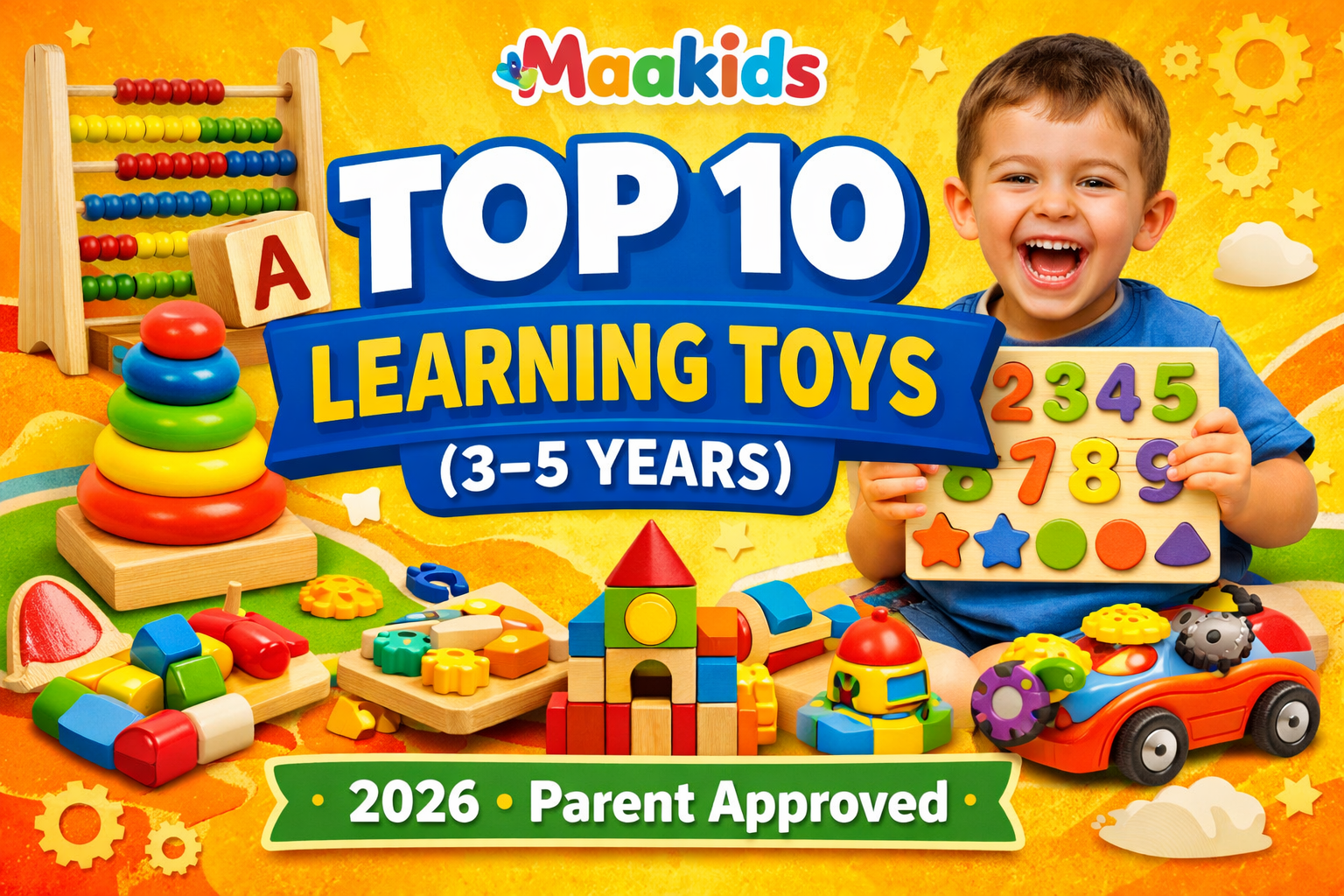
Most toys claim to be “educational” — but very few actually help your child learn.
In this guide, we’ve handpicked the 10 best educational toys for 3–5 year olds that genuinely improve brain development, creativity, and early learning skills — all available in India.
So we went deep. We researched child development science, tested products with real kids, and filtered through hundreds of Amazon listings to find the toys that genuinely build skills — while still being a blast to play with. These aren’t just toys. They’re tools that sneak learning into playtime.
Each pick below targets a real developmental milestone: language, numeracy, fine motor skills, STEM thinking, or creativity. We’ve also flagged what each toy actually teaches so you can match it to your child’s current stage.
💸 Best Educational Toys Under ₹1000 (India)
Many high-quality learning toys for kids aged 3–5 are available under ₹500–₹1000 on Amazon India. These budget-friendly options help develop creativity, problem-solving, and early skills without overspending.
👉 Also explore our latest worksheets and learning resources for kids.
Quick Picks at a Glance
- 1LeapFrog Interactive Learning EaselBest Overall
- 2Magnetic Letters & Numbers SetBest Value
- 3Melissa & Doug Alphabet PuzzleBudget Pick
- 4Magna-Tiles Clear Colors SetBest STEM
- 5Learning Resources Counting BearsBest Math
- 6Orchard Toys Shopping List GameBest Game
- 7Crayola Color Wonder Mess-Free KitBest Creative
- 8Skillmatics Activity MatMost Versatile
- 9Hape Wooden Shape SorterBest Montessori
- 10VTech KidiBeats Drum SetBest Music
The Full List — Reviewed & Ranked
LeapFrog Interactive Learning Easel
This is the one toy we’d buy if we could only pick one. The LeapFrog easel combines a magnetic letter/number board, a dry-erase writing surface, and an interactive display into a single, sturdy unit that grows with your child from age 3 through early school years.
What sets it apart is the interactive feedback — when your child places a letter, the easel says the name, the sound, and a word that starts with it. This multi-sensory learning (seeing + hearing + touching) is backed by child development research as one of the most effective ways to build early literacy.
What it teaches
Parent tip: Use it during a 15-minute “school time” each morning — consistent short sessions work better than occasional long ones for toddlers.
Magnetic Letters & Numbers Set
Deceptively simple and absolutely brilliant. A full set of magnetic letters and numbers on the fridge is one of the most consistently effective early literacy tools used by parents and preschool teachers alike — because it turns idle moments (before breakfast, while you cook) into learning moments.
Kids this age learn through repetition and play, not formal instruction. Having letters visible and playable every day makes the alphabet feel natural and familiar long before formal school begins.
What it teaches
Parent tip: Spell your child’s name every morning and ask them to find each letter. It’s the fastest way to make letters feel personal and meaningful.
Melissa & Doug Alphabet Puzzle
Melissa & Doug have been making quality wooden educational toys for decades, and this alphabet puzzle is a perennial bestseller for good reason. Each letter sits in its own shaped slot, and the picture underneath gives a visual cue — “A is for Apple” — that supports both letter and sound learning simultaneously.
Puzzles are particularly powerful at this age because they combine visual recognition with hand-eye coordination and problem-solving. Unlike screen-based learning, the physical act of placing each piece creates a stronger memory trace.
What it teaches
Parent tip: Don’t do the full alphabet at once. Start with just A–F and celebrate completing that section before moving to the next group.
Magna-Tiles Clear Colors Set
Magna-Tiles are without doubt one of the most beloved educational toys in the world — and for excellent reason. These magnetic geometric tiles let kids build freely in 2D and 3D, quietly absorbing geometry, physics, engineering, and spatial thinking with every structure they create.
Unlike most “STEM toys” that are really just themed puzzles, Magna-Tiles are truly open-ended. A 3-year-old can make flat patterns; a 5-year-old can build castles and vehicles. The toy grows with your child and never gets old.
What it teaches
Parent tip: Place them near a window — the way light passes through the coloured tiles creates natural “wow” moments that spark curiosity about colour and light.
Learning Resources Counting Bears
These colourful little bears are a classroom staple — and now they’re one of the best-reviewed maths tools on Amazon India. The set includes bears in four colours and four sizes, along with sorting cups, making it a multi-skill tool for sorting, counting, comparing, and pattern building.
Early maths anxiety often comes from abstract numbers on paper. These bears make numbers tangible — children can physically see that 5 bears is more than 3 bears, which builds a genuine number sense that paper exercises simply can’t achieve at this age.
What it teaches
Parent tip: Make up simple stories — “Mama bear has 3 yellow bears. Papa gives her 2 more. How many does she have?” Narrative maths sticks far better than drills.
Orchard Toys Shopping List Game
Don’t underestimate how much learning happens inside a well-designed board game. The Orchard Toys Shopping List game asks children to remember a list of grocery items and collect them before anyone else — building memory, vocabulary, turn-taking, and reading readiness all at once.
What’s particularly clever about this game is that it naturally introduces children to real-world objects and their names, which is a cornerstone of early vocabulary development. It’s also genuinely fun for parents, which means you’ll actually play it — a lot.
What it teaches
Parent tip: After the game, ask your child to “write” (draw) their own shopping list. It bridges the game to pre-writing practice beautifully.
Crayola Color Wonder Mess-Free Kit
Every child needs creative outlets — but not every parent can handle permanent marker on the sofa. Crayola’s Color Wonder system uses special markers and paper that only colour where they’re supposed to, making it completely mess-free while preserving all the developmental benefits of drawing and colouring.
Colouring within lines, mixing colours, choosing compositions — these build fine motor control, visual planning, and creative expression. This kit removes the one barrier that makes most parents dread art time: the mess.
What it teaches
Parent tip: Let your child describe what they’ve drawn before praising it. “Tell me about your picture” builds language skills and shows you value their thinking, not just the output.
Skillmatics Activity Mat
Skillmatics is an Indian brand that has won multiple awards for good reason — their reusable activity mats are smartly designed for preschool learning and are widely used in Indian homes and schools. The mats cover letters, numbers, patterns, and shapes in a format children can write on with erasable markers, then wipe clean and use again.
The reusable format is particularly good for this age group because repetition is how they learn — children need to practise the same skill dozens of times, and having a mat they can reset keeps them engaged far longer than a workbook that fills up.
What it teaches
Parent tip: Skillmatics also makes search-and-find mats for Disney and other themes — pick one based on your child’s current favourite characters to instantly boost engagement.
Hape Wooden Shape Sorter & Color Mixer
Hape is a German toy brand beloved by Montessori educators globally, and this shape sorter is one of their most celebrated pieces. It goes beyond the basic “square peg, square hole” concept — children spin colour paddles to mix colours, push shapes through slots, and begin to understand cause and effect in a concrete, tactile way.
The wooden construction matters here. Research consistently shows that wooden toys engage children longer and more deeply than plastic alternatives — the weight, texture, and sound feedback are all richer, which means more time in focused, purposeful play.
What it teaches
Parent tip: Narrate what you see as they play — “Oh, the blue and yellow mixed to make green!” This builds scientific vocabulary naturally through observation.
VTech KidiBeats Drum Set
Music education is consistently linked to stronger maths performance, improved language skills, and better emotional regulation in young children. The VTech KidiBeats set introduces rhythm through an interactive drum kit with multiple modes — free play, learning songs, and instructional beat patterns — making it genuinely educational rather than just fun.
The physical act of drumming also develops bilateral coordination (using both hands and feet together), which is a key developmental milestone in the 3–5 year window.
What it teaches
Parent tip: Clap along and count beats together — “1, 2, 3, 4!” It bridges music and maths in a way that feels completely natural to a 4-year-old.